- →Home-based grooming startups cost $3,000–$8,000 — the most accessible path to ownership
- →Most US states don't require a grooming license, but a business license and liability insurance are non-negotiable
- →Price based on your real costs from day one — underpricing is the hardest mistake to recover from
- →Most groomers reach a full client base within 3–6 months with consistent effort
- →Automated scheduling and client records are what separate organized businesses from chaotic ones
You've been grooming dogs your whole life — for friends, family, maybe at a shelter. Or you've been working in someone else's salon for years and you're done splitting your revenue with an owner who doesn't even know how to hold a clipper.
Either way, you're here because you want to do this for yourself.
Starting a dog grooming business is one of the most realistic paths to self-employment available today. The demand is consistent, the startup costs are manageable, and the market rewards people who simply show up and do good work. But there are decisions to make, steps to follow, and mistakes that cost real money if you don't know about them in advance.
This guide covers everything: how to choose your business model, what it actually costs to get started, which licenses you need, how to price your services, how to find your first clients, and how to set up the systems that keep the business running without running you into the ground.
TL;DR: Starting a dog grooming business costs $3,000–$15,000 for a home-based setup, requires a business license and liability insurance in most states, and most groomers reach a full client base within 3–6 months. The fastest path: pick your model, set correct prices from day one, get on Google, and automate your scheduling before you need to.
Step 1: Choose your business model
The single most important decision you'll make before spending a dollar is which model you're going to operate. Each one has a different startup cost, risk profile, and income ceiling.
Home-based grooming salon
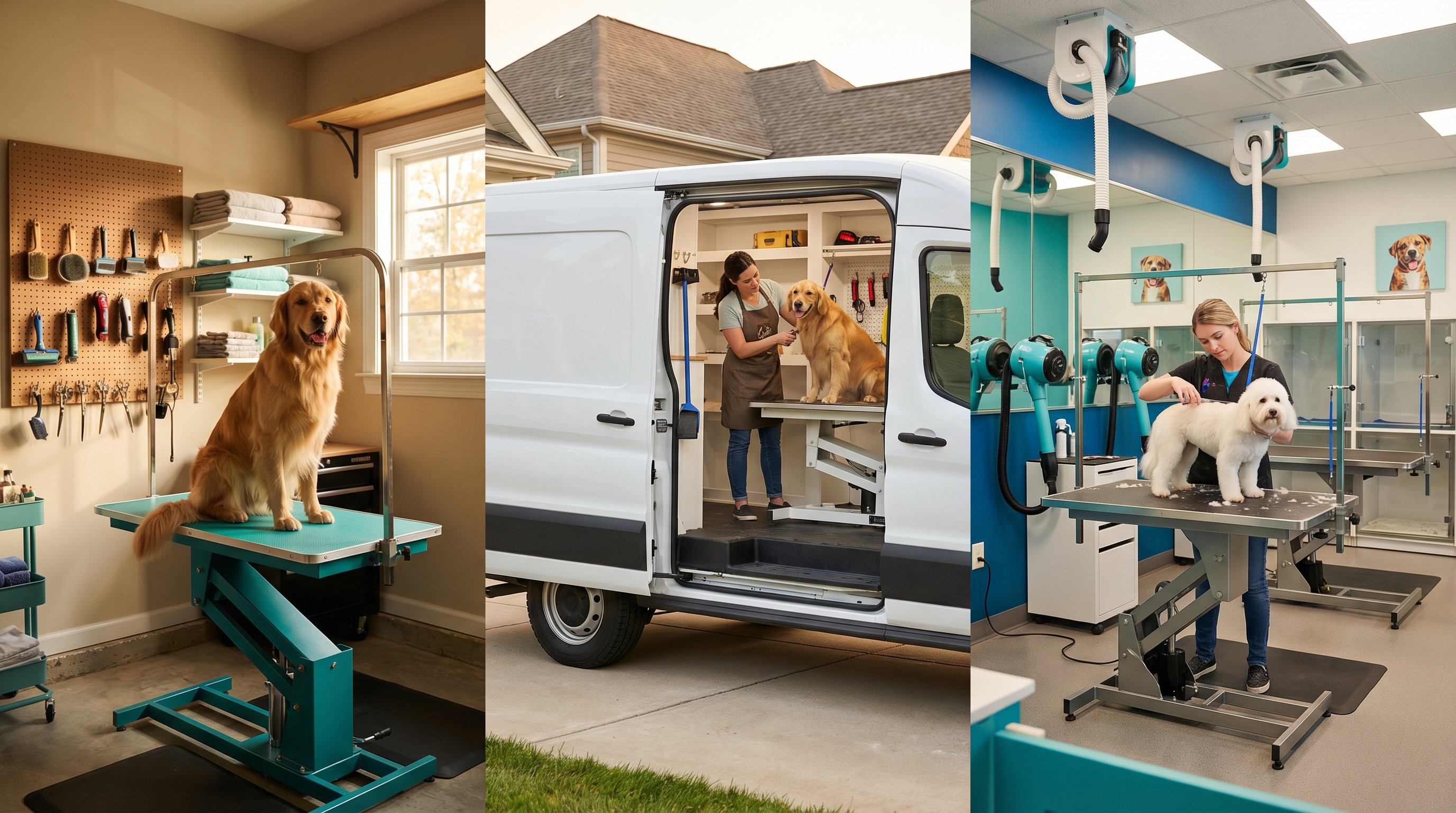
You convert a space in your home — a garage, basement, laundry room, or dedicated room — into a professional grooming area. You work from home, set your own hours, and keep your overhead extremely low.
Best for: Groomers with a suitable home space, low risk tolerance, and who want to start small and grow.
Startup costs: $3,000 – $10,000 for equipment. No rent. Minimal ongoing overhead.
Income ceiling: Limited by how many pets you can physically groom in a day. Most home groomers cap at 5 to 8 pets per day.
Watch out for: Zoning laws. Some residential areas prohibit commercial activity or client traffic at home. Check with your local municipality before investing in the space.
Mobile grooming
You operate out of a specially equipped van or trailer that goes directly to clients' homes. No salon, no waiting room, no client drop-off. You come to them.
Best for: Groomers who want higher per-appointment revenue and flexibility without being tied to one location.
Startup costs: $20,000 – $100,000 depending on whether the van is new or used and how it's equipped.
Income ceiling: Higher per appointment — clients pay a premium for the convenience — but you're limited by geography and drive time between stops.
Watch out for: Vehicle maintenance and downtime. If your van is in the shop, you're not working. Build a maintenance reserve into your budget from day one.
Brick-and-mortar salon
You rent or lease a commercial space, build it out for grooming, and operate as a traditional storefront.
Best for: Groomers with experience, capital, and a plan to hire staff and scale.
Startup costs: $20,000 – $75,000+ depending on buildout, location, and equipment needs.
Income ceiling: Essentially unlimited — you can hire additional groomers, expand your service menu, and build a recognizable brand in your community.
Watch out for: Lease commitments. Don't sign a multi-year lease until you've validated your market.
Booth rental or salon suite
You rent a chair or suite inside an existing pet salon or multi-service facility and operate as an independent contractor within someone else's space.
Best for: Groomers who want their own client base and pricing without the overhead of a full buildout.
Startup costs: $500 – $2,000 for equipment plus ongoing booth rent ($200 – $800/month).
Watch out for: You're dependent on the host business's foot traffic, reputation, and policies. Read your rental agreement carefully.
Step 2: Handle the business and legal basics
Before you take your first paying client, get your business foundation in place. Most of this can be done in a day or two — and skipping it creates problems that are much harder to fix later.
Choose a business structure
Sole proprietorship is the simplest option. You operate under your own name or a DBA ("doing business as"), and business income is reported on your personal taxes. No registration required in most states beyond a DBA filing.
LLC (Limited Liability Company) separates your personal assets from your business liabilities. If a dog bites another dog in your care, or if you're sued for any reason, your personal savings and property are protected. For a grooming business, an LLC is worth the $50 to $500 filing fee. Most groomers move to an LLC structure within their first year.
The most common path: start as sole proprietor to keep it simple, convert to LLC once you're generating consistent revenue.
Get your licenses and permits
Licensing requirements vary significantly by state and municipality. Here's what to check:
- Business license — Most cities and counties require a general business license to operate commercially. Cost: typically $25 to $100 per year.
- Zoning permit / home occupation permit — If you're operating from home, confirm your zoning allows it and whether you need a permit.
- State grooming license — Most US states do not require a specific grooming license. A small number, including California, do. Check your state's Department of Consumer Affairs.
- Sales tax permit — If your state taxes grooming services (most do), you'll need a seller's permit to collect and remit sales tax.
Pro tip: Call your local Small Business Administration (SBA) office and ask: "I'm opening a pet grooming business. What permits and licenses do I need?" One 20-minute conversation usually covers everything for your specific city and state.
Get business insurance
This is non-negotiable. One incident — a dog biting another dog, a pet having a reaction to a product, a client slipping on your floor — can result in costs that wipe out an uninsured business.
General liability insurance with care, custody, and control coverage specifically protects you when animals are in your care. Standard GL policies often exclude animals. Pet business-specific insurers like Pet Business Insurance or PETPROTECT offer policies starting around $400 per year.
For the full breakdown of what coverage you actually need, see our guide to dog grooming business insurance.
Step 3: Set up your space and equipment
Essential equipment — what you actually need on day one
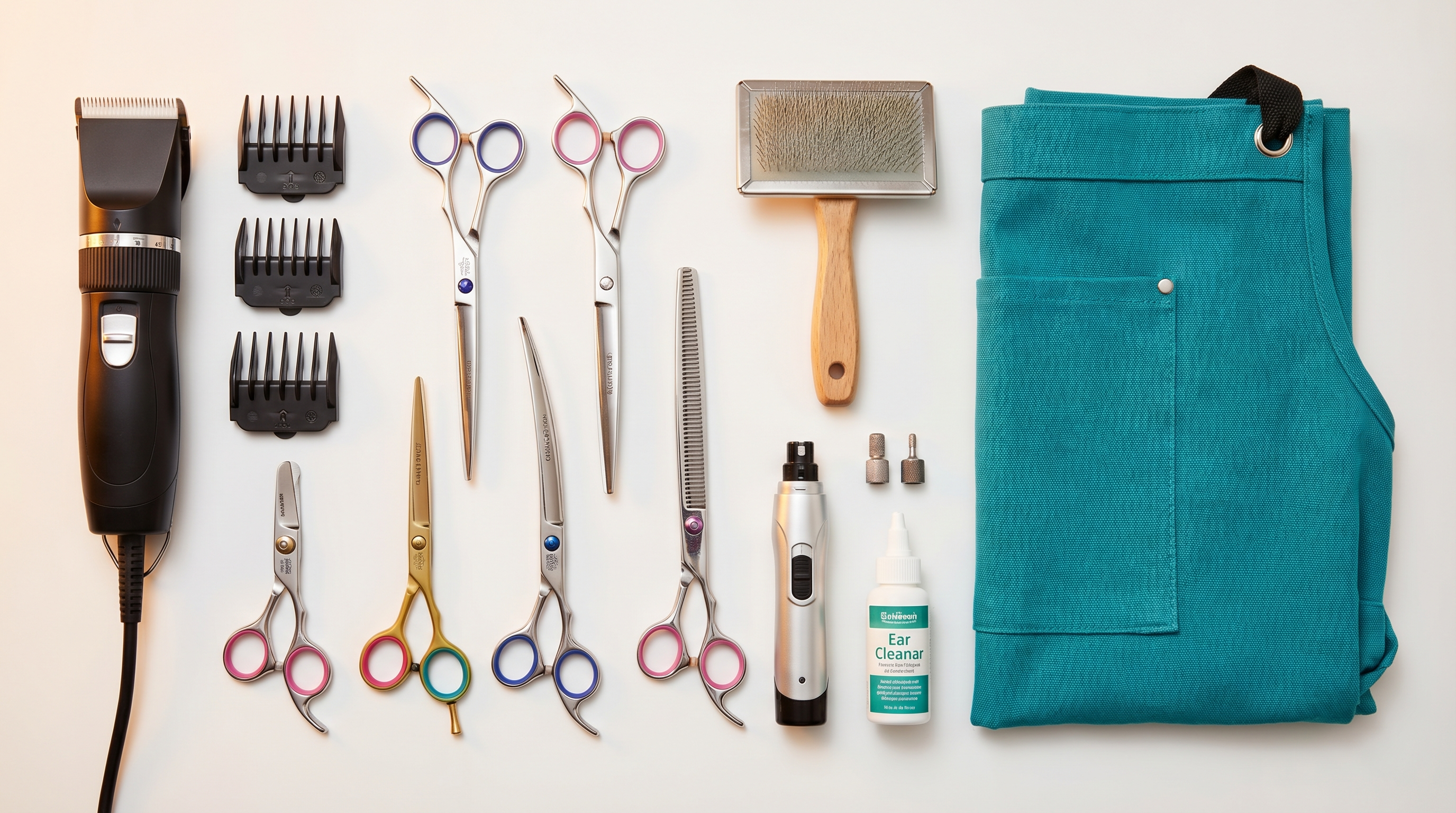
You don't need everything at once. Here's what's truly essential versus what you can add as revenue grows.
| Equipment | Estimated cost |
|---|---|
| Professional grooming table (hydraulic or electric preferred) | $200 – $800 |
| High-velocity force dryer | $150 – $500 |
| Clippers — 2 sets minimum, always have a backup | $150 – $500 |
| Clipper blades — assorted sizes | $100 – $300 |
| Shears — at least 3 pairs: straight, curved, thinning | $150 – $600 |
| Slicker brushes, dematting combs, deshedding tools | $50 – $150 |
| Grooming tub or tub conversion | $200 – $800 |
| Shampoos and conditioners — starter stock | $100 – $250 |
| Nail clippers and grinder | $30 – $100 |
| Ear cleaning supplies | $20 – $50 |
| Total essential startup | $1,180 – $4,130 |
Add a stand dryer, retail shelving, and upgraded tools as revenue grows — not before.
For mobile grooming: the van essentials
Your van is your business. The components that matter:
- Fresh water tank (minimum 40 gallons) and waste water tank of the same capacity
- Water heater — propane or electric; cold water baths are not acceptable
- Generator (minimum 3,500 watts) or shore power hookup
- Grooming tub with proper drainage
- High-velocity dryer rated for your generator's capacity
- Good ventilation — your respiratory health depends on it over the long term
Used grooming vans with full setups sell for $15,000 to $40,000. New purpose-built units run $50,000 to $100,000+. Starting with a used van in good mechanical condition is the most common and practical path for new mobile groomers.
For a detailed cost breakdown across all business models, see dog grooming business startup costs.
Step 4: Price your services correctly from day one
Pricing is where most new grooming businesses make their first significant mistake — and it's one that's very hard to correct later. Clients anchored to your early pricing will resist increases, and you'll spend years playing catch-up.
The rule: Price based on your actual costs and your market — not on what you think clients will accept. Underpricing is not a client acquisition strategy. It's a trap.
Calculate your minimum viable price
Step 1: Add up your monthly fixed costs — insurance, software, supplies, vehicle, phone, and any rent or overhead.
Step 2: Decide how many appointments you can realistically do per month. Part-time: 60 to 80. Full-time: 120 to 180.
Step 3: Divide your overhead by your appointment count. This is the floor each appointment must cover before you pay yourself anything.
Step 4: Add your target hourly rate × average appointment duration. A groomer targeting $25/hour who averages 1.5 hours per appointment needs $37.50 per appointment just for labor.
Step 5: The sum of steps 3 and 4 is your minimum viable price. Anything below this and you're losing money.
Typical price ranges by service type
| Service | Small dog | Medium dog | Large dog | Extra large |
|---|---|---|---|---|
| Bath and brush out | $35 – $55 | $45 – $70 | $65 – $95 | $85 – $130 |
| Bath and full haircut | $55 – $80 | $70 – $100 | $90 – $140 | $120 – $180 |
| De-shedding treatment | $40 – $65 | $55 – $90 | $75 – $120 | $95 – $150 |
| Nail trim only | $15 – $25 | $15 – $25 | $20 – $30 | $20 – $35 |
| Ear cleaning | $10 – $20 | $10 – $20 | $15 – $25 | $15 – $25 |
Mobile groomers typically charge 25 to 40% more than home or salon-based groomers for the same service.
For a deeper dive on pricing strategy, read how to price your dog grooming services.
Add-ons: where the real margin lives
A client who pays $70 for a full groom and adds nail grinding, ear cleaning, and teeth brushing might walk out at $105 — with no significant additional appointment time. Add-ons are where grooming businesses build real margin without adding appointments. See the complete guide to dog grooming add-on services.
Step 5: Build your client base
You can have the cleanest salon, the best clippers, and a perfect price list — and still fail if no one knows you exist. Getting your first clients is the most important marketing you'll ever do.
Start with your immediate network
Before you spend a dollar on marketing, tell everyone you know. Friends, family, neighbors, former coworkers. Offer them an introductory rate — not free, a discount — in exchange for an honest Google review. Your first 10 to 15 clients will likely come entirely from your personal network. Their referrals will fuel your next 20.
Claim your Google Business Profile
The single most important free marketing tool for any local grooming business. Go to business.google.com and claim your profile before you open. Fill out every field — hours, services, photos, phone number, website. When someone searches "dog groomer near me," your listing is what appears.
Ask every satisfied client for a Google review. A grooming business with 25 reviews averaging 4.8 stars will outrank any competitor without reviews, regardless of how long they've been open.
Instagram and TikTok
Before-and-after transformations are the highest-performing organic content type for grooming businesses. Your phone, a clean background, and good lighting are all you need. Post consistently — three times per week — and use local hashtags to reach people in your area.
Referral partnerships
Vets, dog trainers, boarding facilities, and pet supply stores are all businesses whose clients are also your potential clients. Introduce yourself, ask if they'd be willing to refer clients who ask for grooming recommendations, and offer to return the favor. One strong veterinary referral relationship can send a steady stream of new clients indefinitely.
For the full playbook on growing your client base without paid advertising, see how to get more dog grooming clients.
Step 6: Set up your business systems
This is the step most new groomers skip — and the reason most grooming businesses hit a ceiling around 30 to 40 clients and can't grow further without chaos. The chaos isn't caused by the clients. It's caused by the absence of systems.
Appointment scheduling
Every appointment needs to be confirmed, reminded, and tracked. At 5 appointments a day, you can manage with a notebook. At 40 clients in your rotation, a missed appointment or double-booking doesn't just cause embarrassment — it costs you money and damages client trust.
Automated reminders reduce no-shows by 30 to 50% for most groomers. ZendPaw handles this automatically — reminders go out in English or Spanish per each client's preference, before every appointment, without you doing anything.
Client records
Every pet needs a profile: breed, coat condition, temperament notes, service history, owner preferences. At 5 to 8 pets a day, 22 working days a month, you'll be servicing over 100 unique animals. A client card for every pet — accessible in seconds at the start of each appointment — is what separates a professional operation from a chaotic one.
No-show and cancellation policy
The math: One no-show per day at a $75 average is $1,500 per month in lost revenue. Two no-shows per week is $7,800 per year — gone.
A simple policy: require a deposit for new clients' first appointment, and require 24-hour notice for cancellations. Communicate this clearly upfront. Most clients respect it. The few who don't were going to be problems anyway.
For the full breakdown on preventing no-shows, see how to reduce no-shows at your grooming salon.
Revenue tracking
Know your numbers every week: how much you made, which services generated it, what your average ticket was. This information tells you when to raise prices, when to add marketing effort, and when you're actually ready to go full time. The groomers who grow fastest aren't always the most skilled — they're the most organized.

Step 7: Think about the long game
Once you have 20 to 30 regular clients and a functioning system, the business starts to feel sustainable. Then the question becomes: where does this go?
When to raise prices
The signal isn't the calendar — it's your booking status. If you're consistently full two or more weeks out and turning away clients, you're underpriced. A 10 to 15% increase with 3 to 4 weeks of advance notice results in minimal client loss and a meaningful revenue jump. Most established groomers raise prices once a year. Read the full guide on how much you can raise grooming prices without losing clients.
When to go full time
If you're currently grooming on weekends or evenings alongside a day job, the question of when to go full time is the most consequential decision you'll face. The answer isn't a feeling — it's a calculation. See the complete guide to going from side hustle to full-time groomer.
The startup cost summary
| Business model | Startup cost range | Monthly overhead |
|---|---|---|
| Home-based (basic) | $3,000 – $8,000 | $200 – $600 |
| Home-based (professional) | $8,000 – $15,000 | $300 – $800 |
| Mobile (used van) | $20,000 – $45,000 | $800 – $1,800 |
| Mobile (new van) | $60,000 – $100,000+ | $1,500 – $3,000 |
| Brick-and-mortar salon | $20,000 – $75,000+ | $3,000 – $8,000+ |
Frequently Asked Questions
Do I need formal grooming training or certification to start a dog grooming business?
Most US states don't require formal certification to operate as a pet groomer. That said, professional training dramatically improves work quality and reduces the risk of injuring a pet. Programs through the National Dog Groomers Association of America (NDGAA) or International Professional Groomers (IPG) are well regarded and help justify higher pricing.
How long does it take to get fully booked?
Most groomers with consistent marketing effort reach a comfortably full schedule within 3 to 6 months. The first 4 to 6 weeks are the slowest — gaps in your calendar are normal. By month 3, referrals start compounding. By month 6, most well-run grooming businesses are turning away appointments.
How much can I realistically earn as an independent groomer?
A solo groomer doing 6 appointments per day at a $70 average generates around $9,240 per month in revenue. After expenses, most established home-based groomers net $4,000 to $7,000 per month. Mobile groomers typically net more per appointment. See the full income breakdown in how much do dog groomers make.
What insurance do I actually need?
At minimum: general liability insurance with care, custody, and control coverage for animals. Pet business-specific policies start around $400 per year. Read the full guide to dog grooming business insurance.
What software do I need to run a grooming business?
At minimum, a way to manage appointments and client records. ZendPaw handles scheduling, automated reminders, client and pet profiles, deposit collection, and basic reporting — starting at $39/month. It's the operational foundation that keeps your business organized as it grows. Start your 14-day free trial at zendpaw.com.
How do I handle a situation where a dog gets injured in my care?
Document everything immediately — photos, a clear timeline, what happened. Contact your insurance provider before speaking with the client about liability. Notify the owner honestly and with care. This is exactly why insurance is non-negotiable from day one.
Ready to stop managing your schedule on paper?
14-day free trial · Cancel anytime
Start My Free Trial →