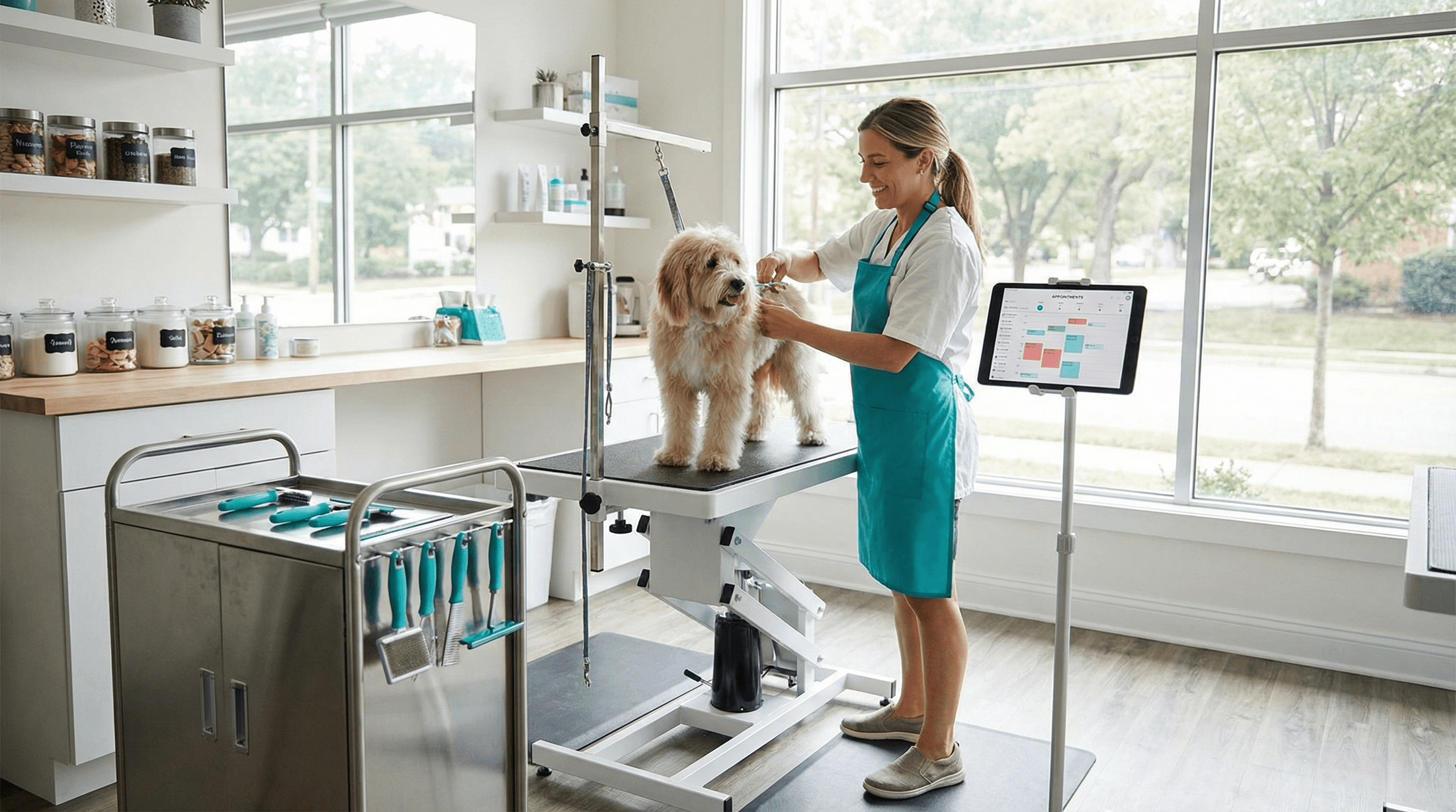
- →The 4 readiness benchmarks: turning away clients, income covers essentials, 3 months savings, consistent referrals
- →Most groomers reach a full-time income target within 6–12 months of starting as a side hustle
- →6 appointments a day at a $65 average generates over $8,500 USD per month — sustainable full-time income
- →Automated scheduling, client records, and deposit collection are non-negotiable at full-time volume
- →Underpricing is the most common reason groomers delay the transition longer than necessary
At some point, you run the numbers.
You're grooming on weekends and the occasional weekday off. The money is good — better per hour than your day job, honestly. The clients are starting to come back. A few have referred their friends. And somewhere between shampooing a Golden Retriever on a Saturday morning and sitting in a meeting on Monday that could have been an email, you start to wonder: could I actually do this full time?
The answer, for most groomers who ask that question, is yes. But the transition from side hustle to full-time business is less about skill and more about timing. Go too early and you're stressed about rent. Go too late and you've spent years in a job you don't want to be in.
Here's a realistic timeline and the markers that tell you you're ready.
What "ready" actually looks like
There's no universal signal that says "quit your job now." But there are a few concrete benchmarks that consistently separate groomers who make a successful transition from those who go back to employment within a year.
Benchmark 1: You're turning away clients. When you're regularly telling clients you don't have availability — not occasionally, but consistently, week after week — your demand has outgrown your current capacity. That's the most reliable signal that the market wants what you're offering.
Benchmark 2: Your grooming income covers your essential expenses. Not your full income replacement. Your essentials — housing, food, utilities, insurance, transportation. If your side hustle income already covers those, the leap becomes significantly less scary. You're not starting from zero; you're filling in the margin.
Benchmark 3: You have 3 months of expenses saved. This is the buffer that saves most grooming businesses in their first year. Slow months happen. Equipment breaks. A client base takes time to reach full capacity. Three months of runway means you can navigate those moments without panicking or going back to a day job.
Benchmark 4: You have a waiting list or consistent referrals. A waiting list means demand is real and sustainable, not a burst of early excitement. Consistent referrals mean clients are satisfied enough to tell other people — which is the foundation of a stable grooming business.
If you have all four of these, you're not just ready — you're overdue.
The realistic timeline
Everyone's situation is different, but here's a common pattern among groomers who make the transition successfully.
Months 1–3: Build the foundation
Start grooming on evenings and weekends. Focus on getting your first 10 to 15 clients and serving them exceptionally well. Don't worry about marketing yet — word of mouth from your first clients is your most important asset right now.
At this stage: get your business registered, open a separate business bank account, set up a basic scheduling system, and start tracking every appointment and dollar. Building these habits early makes everything easier later.
Income target: $500 – $1,500 USD / $8,000 – $25,000 MXN per month. Enough to validate demand, not yet enough to live on.
Months 4–6: Fill your side-hustle calendar
Keep adding clients until your available hours are full. If you're grooming Saturdays and Sunday mornings and have two evenings per week available, fill all of those slots before you think about going full time.
Use this period to test your pricing, refine your services, build your Google reviews, and develop a consistent social media presence. The habits you build here scale directly into full-time operation.
Income target: $1,500 – $3,000 USD / $25,000 – $50,000 MXN per month. Approaching essential-expense coverage.
Months 7–12: The transition window
This is when the math usually starts to work. You're fully booked in your available hours, turning away clients you could serve if you had more time, and your grooming income is approaching or matching what you need to cover your basics.
Start planning the logistics of the transition: notice period for your current employer, health insurance coverage, business insurance, equipment upgrades if needed. Don't quit impulsively — plan a date 6 to 8 weeks out and use that time to prepare.
Income target: $3,000 – $5,000 USD / $50,000 – $85,000 MXN per month. Full essential-expense coverage plus some margin.
Month 12+: Full time
You've made the leap. The first few weeks feel strange — the freedom is real, but so is the weight of knowing all income depends on you. That feeling fades.
Focus on: filling your expanded calendar with the new availability, raising prices if you haven't in the past 6 months, adding one or two service offerings, and building the systems that keep the business running smoothly so your job is grooming, not administration.
Income target: $4,000 – $7,000 USD / $65,000 – $115,000 MXN per month at comfortable full-time capacity. Varies significantly by market, services, and model.
What slows the transition down
A few things consistently delay the timeline for groomers who should have made the leap sooner.
Underpricing. If you're charging $30 for a full groom because you "just started" or "don't want to scare clients away," you need more clients to reach the same income target as someone charging $65. Correct your pricing before you scale, not after.
No tracking. Groomers who don't track appointments, revenue, and expenses can't make the income calculation that tells them they're ready. If you don't know what you're making, you can't plan a transition.
Fear of not having benefits. Health insurance, paid time off, retirement contributions — these are real concerns. Factor them into your income target (they add roughly $300 to $600 USD per month in the US) but don't let them become reasons to stay stuck indefinitely. Self-employed groomers can access health coverage through the marketplace, and the flexibility of self-employment has its own value.
Waiting for "the right time." There's no perfect moment. There will always be a reason to wait another few months. The benchmarks above exist so you can evaluate readiness objectively, not emotionally.
The systems that make full-time work sustainable
The difference between groomers who burn out within a year of going full time and those who build thriving, lasting businesses is almost always systems.
When you're a side hustler, you can manage appointments in your head and chase clients by text. When you're doing 8 appointments a day, that approach falls apart fast.
Scheduling: Every appointment needs to be in one place, visible, and confirmed. Missed appointments at full-time volume are missed rent money. Automated reminders aren't a nice-to-have — they're essential. ZendPaw sends them automatically in English or Spanish, per client preference, so you're not texting 40 people a week to confirm their appointments.
Client records: You need to know every pet's breed, size, coat condition, temperament notes, and service history before you pick up the clipper. At 8 pets a day you cannot hold this in memory. A client card for every pet, accessible in seconds, is what separates professional operations from chaotic ones.
Revenue tracking: Know your weekly and monthly numbers. Which services generate the most income. Which clients come back most reliably. Where your slow periods are. This information tells you when to raise prices, when to add marketing effort, and when to consider hiring help.
Deposit collection: Full-time groomers cannot absorb no-shows the way side hustlers can. A single no-show as a side hustler is an annoyance. Three no-shows in a full-time week is a significant income gap. Collecting deposits for new clients and implementing a cancellation policy is non-negotiable at full capacity.
Making the financial case to yourself
Here's a simple calculation to run:
Step 1: Add up your essential monthly expenses — rent/mortgage, food, utilities, insurance, transportation, phone, debt minimums. This is your floor.
Step 2: Add 30% for taxes (rough estimate for self-employment in the US; adjust for your country and situation).
Step 3: Add $300 to $500 for business expenses — supplies, insurance, software, marketing.
Step 4: Add whatever savings target makes you feel secure.
The result is your monthly grooming revenue target. Divide by your average ticket price. That's how many appointments per month you need. Divide by 22 working days. That's how many appointments per day.
Most groomers are shocked by how achievable that number is. Six appointments a day at $65 average is $390/day, $8,580/month. That's a fully sustainable full-time income in most markets — and most experienced groomers can do six appointments comfortably.
Frequently Asked Questions
Do I need to incorporate or form an LLC before going full time?
Not necessarily before, but soon after. Operating as a sole proprietor is fine to start. An LLC provides liability protection and some tax benefits worth having once you're earning full-time income from grooming. Consult a local accountant — the setup cost is typically $100 to $500 USD and worth it.
What about health insurance?
In the US, self-employed people can purchase coverage through healthcare.gov. Costs vary by plan and income level. Budget $200 to $500 USD per month for a reasonable individual plan. In Mexico and many LATAM countries, estilistas caninos independientes can access IMSS through voluntary affiliation.
How many clients do I need before going full time?
The number matters less than the income. A groomer doing 5 appointments a day at $70 average is generating more than one doing 8 at $40. Focus on the income calculation, not the client count. That said, having at least 30 to 40 active, returning clients provides enough stability to make the transition with confidence.
What if I go full time and it doesn't work out?
You go back to employment — and you're not worse off for having tried. Most groomers who've made the transition and come back report that they had a timing issue (went too early) rather than a skills or market issue. The second attempt, with better timing, usually succeeds.
Should I tell my current employer I'm planning to leave?
Not until you're ready to give formal notice. Build your grooming business quietly and professionally. When you're ready, give appropriate notice (two weeks is standard) and leave on good terms. You never know when a former employer might become a client or a referral source.
Ready to stop managing your schedule on paper?
14-day free trial · Cancel anytime
Start My Free Trial →