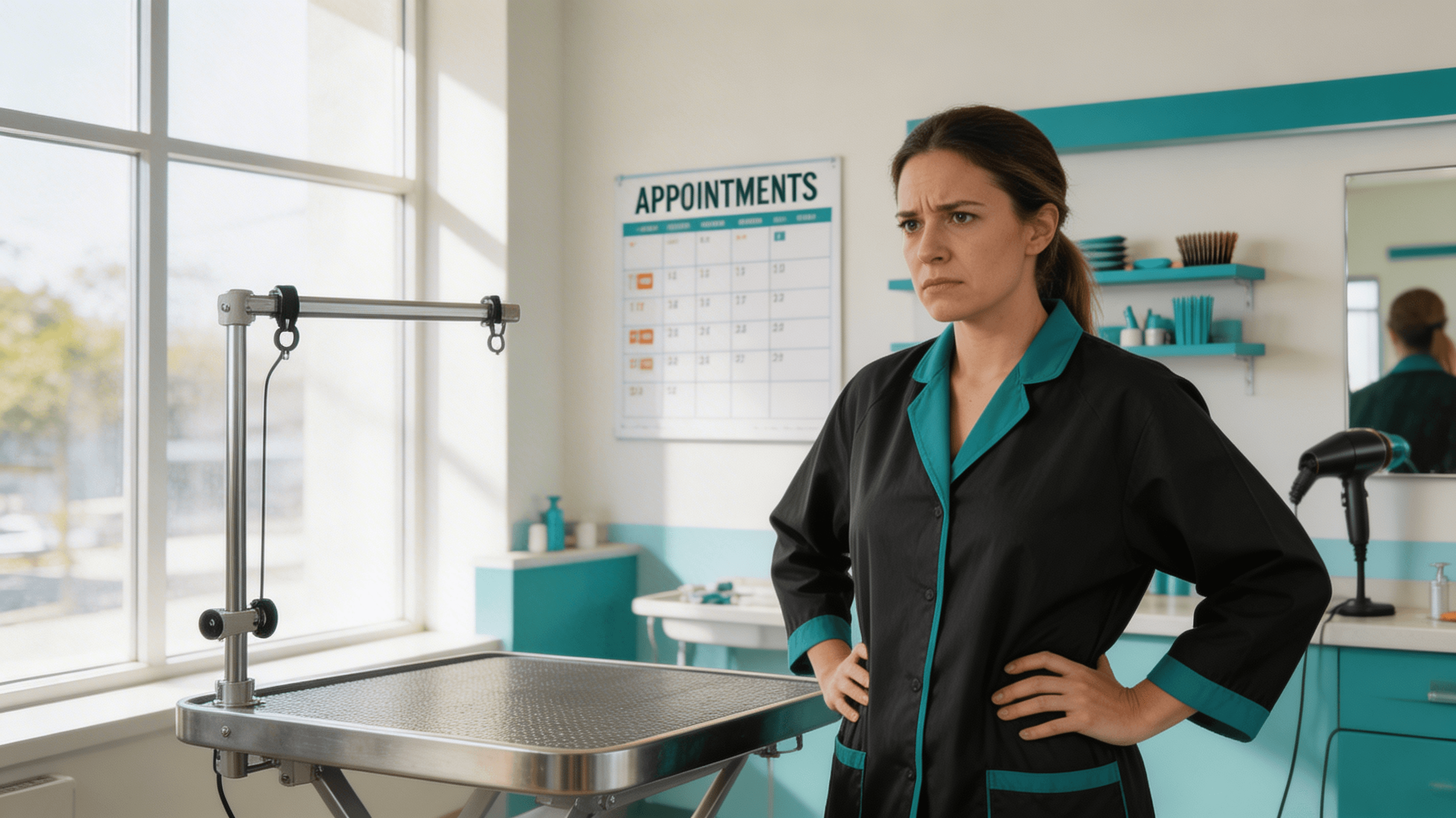
- →A single no-show can cost $122–$265 when you factor in lost revenue, supplies, and opportunity cost
- →A grooming business with a 8% no-show rate on 30 appointments per week loses $8,736 per year
- →Automated reminders at 72 and 24 hours before appointments are the single highest-impact fix
- →Deposits at booking — even $15–$25 — dramatically reduce no-show rates by creating commitment
- →Reducing no-shows from 8% to 3% recovers $5,000+ per year without adding a single new client
Most groomers know no-shows are expensive. What most groomers don't know is exactly how expensive — because they've never sat down and done the math.
This post gives you the framework to calculate your actual no-show cost, understand what's driving it, and take specific steps to reduce it. The numbers tend to be sobering. They're also motivating.
What a no-show actually costs you
A no-show isn't just a missed appointment. It's a blocked time slot that could have been filled, supplies you may have already prepared, and administrative time spent chasing a client who didn't show up.
Here's the full cost breakdown of a single no-show:
| Cost component | Typical value |
|---|---|
| Lost appointment revenue | $55–$120 |
| Supplies prepared but unused | $4–$10 |
| Time spent following up | 10–15 min ($8–$15 value) |
| Opportunity cost (slot not rebooked) | $55–$120 |
| Total cost per no-show | $122–$265 |
The opportunity cost is the number most groomers underestimate. A no-show at 10am on a Tuesday doesn't just cost you that appointment — it costs you the appointment you could have booked in that slot if you'd known in advance.
How to calculate your personal no-show cost
Every grooming business is different. Here's how to calculate yours specifically:
Step 1 — Find your no-show rate
Pull your last 90 days of appointment records. Count total appointments scheduled and total no-shows (including same-day cancellations with no rebook).
No-show rate = No-shows ÷ Total appointments scheduled × 100
Based on industry observations, grooming businesses typically see no-show rates between 5–12%, based on industry observations. If you're above 10%, you have a significant problem worth solving aggressively.
Step 2 — Calculate your weekly no-show cost
Weekly no-show cost = (Appointments/week × No-show rate) × Average appointment price
Example: 30 appointments/week × 8% no-show rate × $70 average = $168/week lost
That's $8,736/year from no-shows alone — before accounting for the opportunity cost of unfilled slots.
Step 3 — Calculate your annual exposure
| Your numbers | Example | Your business |
|---|---|---|
| Appointments per week | 30 | ___ |
| No-show rate | 8% | ___ |
| Average appointment price | $70 | ___ |
| Weekly loss | $168 | ___ |
| Annual loss | $8,736 | ___ |
Fill in your numbers. If the annual figure surprises you, you're not alone — most groomers who run this calculation for the first time find the number significantly higher than they expected.
What drives no-shows in grooming businesses
Not all no-shows have the same cause — and the fix depends on understanding which type you're dealing with.
Forgotten appointments
The most common cause. A client books 6 weeks out, life gets busy, and the appointment simply slips their mind. This has nothing to do with their commitment to your business — it's a pure communication gap.
Fix: Automated reminders at 72 hours and 24 hours before the appointment. A client who receives two reminders and still no-shows is a different problem entirely.
Chronic no-show clients
Some clients repeatedly no-show or cancel last minute. They're not malicious — they just have chaotic schedules and low accountability. Without a consequence, the behavior continues.
Fix: A deposit requirement or strict cancellation policy for clients with 2+ no-shows. Track no-show history per client so you can identify the pattern before it repeats.
Price sensitivity
Clients who were already on the fence about the cost sometimes "forget" an appointment rather than cancel. It's avoidance behavior — they don't want the confrontation of cancelling.
Fix: Deposits at booking convert wavering clients into committed ones. If they've paid something, they show up.
Scheduling too far in advance
Bookings made 8–12 weeks out have higher no-show rates than bookings made 2–3 weeks out. The further out the appointment, the more life can intervene.
Fix: For new clients especially, try to book within 2–3 weeks for the first appointment. Once the relationship is established, longer advance bookings become lower risk.
The three tools that reduce no-shows most effectively
1. Automated reminders
This is the single highest-impact change most grooming businesses can make. A reminder sent 72 hours out gives clients time to reschedule if needed — which is far better than a no-show. A reminder at 24 hours catches last-minute conflicts.
The key word is automated. Reminders you send manually don't get sent consistently. A system that sends them automatically (like ZendPaw's automated reminder feature) — every time, without you thinking about it — is what actually moves the needle.
2. Deposit collection
Requiring a deposit at booking — even $15–$25 — dramatically reduces no-show rates. Clients who have paid something have skin in the game. The psychological commitment changes their behavior.
Deposits also filter out low-commitment clients before they waste a slot. A client who won't pay a $20 deposit to secure a grooming appointment is probably the same client who was going to no-show anyway.
3. A clear cancellation policy
Clients follow rules that are clearly communicated upfront. A policy that requires 24-hour notice to cancel without a charge — stated at booking, visible on your website, and referenced in your reminder messages — sets expectations before anything goes wrong.
The policy doesn't need to be harsh. It needs to be clear. Most clients who understand that last-minute cancellations affect a small business will make the effort to notify you — they just need to know it matters.
"Reminders and automatic confirmations is a life saver. We don't answer calls as much and it saves so much time."
What to do when a no-show happens anyway
Even with every system in place, some no-shows will happen. Here's the protocol:
Immediately: Send a brief, non-confrontational message.
"Hi [Name] — we had you scheduled for [time] today and didn't see you. We hope everything is okay. Please reach out when you'd like to reschedule."
This opens the door without accusation. Most clients who no-show feel embarrassed — a warm message often brings them back.
After 48 hours with no response: Follow up once more, then move on. A client who no-shows and goes silent is telling you something about the relationship.
Track it: Add the no-show to the client's record. Two no-shows should trigger a deposit requirement for all future bookings. Three no-shows should make you reconsider the relationship entirely.
Rebook the slot: The moment a no-show is confirmed, reach out to your waitlist or next available client. Recovering even one slot per no-show significantly reduces the real cost.
The no-show math after you fix the problem
Here's what the same business looks like after implementing reminders, deposits, and a cancellation policy:
| Metric | Before | After |
|---|---|---|
| No-show rate | 8% | 2–3% |
| Weekly no-shows | 2.4 | 0.6–0.9 |
| Weekly loss | $168 | $42–$63 |
| Annual savings | — | $5,460–$6,552 |
Reducing your no-show rate from 8% to 3% on a 30-appointment week recovers over $5,000 per year — without adding a single new client or working one extra hour.
If you want to dig deeper into the strategies behind no-show prevention, how to reduce no-shows at your grooming salon covers the full playbook — reminder timing, deposit structures, cancellation policy templates, and how to handle repeat offenders.
Ready to stop managing your schedule on paper?
14-day free trial · Cancel anytime
Start My Free Trial →