- →Stop losing money to last-minute cancellations and no-shows. Here's exactly what to include in your grooming cancellation policy — plus three templates you can steal today.
It's 9:47 on a Wednesday. Your 10am just texted: "So sorry, something came up, can we reschedule?" You blocked out 90 minutes for a full groom on a doodle. You turned down a walk-in Tuesday to hold it. And now you're standing in your salon with wet hands, staring at $85 that just evaporated.
TL;DR: A strong dog grooming cancellation policy needs five things: a clear notice window (usually 24 or 48 hours), a cancellation fee ($25–50 is standard), a no-show fee (50–100% of service), a late arrival rule, and a trigger for requiring deposits from repeat offenders. The policy itself is the easy part — enforcing it consistently is what separates groomers who get paid from those who don't.
If this happens once a month, it's annoying. If it happens once a week, it's a real business problem — two same-day cancellations a week at $75 average is approximately $7,800 (2 × $75 × 52 weeks = $7,800) in lost revenue a year. A written dog grooming cancellation policy is how you stop it.
Here's exactly what to include in yours, how much to charge, three templates you can adapt in the next ten minutes, and — the part most guides skip — how to actually enforce it without scaring off good clients.
Why a dog grooming cancellation policy matters more than most industries
A hair salon that loses a 45-minute appointment to a no-show loses 45 minutes. A groomer that loses a 2-hour doodle appointment loses two hours and a bathing slot, a drying slot, a finishing slot, and the specific time-of-day window they reserved for that dog's breed and temperament.
Grooming appointments aren't interchangeable. You can't slot in a walk-in Shih Tzu at 10am when you've prepped for a 55-pound Bernedoodle. That's what makes last-minute cancellations particularly expensive in this business — and why a vague "please give us notice" policy doesn't cut it.
A well-written policy does four things at once:
- Protects your revenue when clients cancel without enough notice to rebook the slot
- Trains client behavior — when clients know the rules upfront, most of them follow them
- Gives you a clean way to say no to chronic cancellers without awkward conversations
- Makes you look professional, which ironically leads to clients respecting your time more
The 5 things every grooming cancellation policy must include
Every working cancellation policy in the grooming industry contains the same five elements. Strip any one of them out and you've got a policy with a hole big enough to drive a mobile grooming van through.
1. The notice window
How far in advance must a client cancel or reschedule to avoid a fee? The industry standard for grooming is 24 to 48 hours. Busier salons with long waitlists often require 72 hours for cancellations on full grooms.
- 24 hours — Standard for newer businesses and flexible groomers still building a client base
- 48 hours — Standard for established solo groomers and most salons
- 72 hours — Used by high-demand salons with waitlists longer than two weeks
Pick one number and stick to it. Don't vary it by service or client — that creates exceptions you'll have to explain forever.
2. The cancellation fee
What clients pay if they cancel inside the notice window. Industry range is $25–$50 for a standard cancellation, or 50% of the service price for higher-priced appointments.
A $25 flat fee is easier to enforce because clients know exactly what they'll be charged. Percentage-based fees ($75 groom × 50% = $37.50) feel more fair on expensive services but require more math at the register.
3. The no-show fee
A no-show is worse than a late cancellation because you got zero warning. Most groomers charge 50–100% of the full service price for no-shows. Some require a new deposit before booking the client again.
This is where your policy needs teeth. A $25 no-show fee on a $95 doodle appointment doesn't protect you — it just feels like a token gesture.
4. The late arrival rule
Clients who show up 15+ minutes late throw off your entire day. Your policy should cover:
- How long the grace period is (usually 10–15 minutes)
- Whether late clients can still be serviced (case-by-case, groomer's discretion)
- Whether a late arrival that becomes a cancellation is charged as a cancellation or a no-show (usually no-show)
5. The deposit trigger
This is the part most groomers forget, and it's the most powerful. Your policy should say that clients who cancel late or no-show are required to prepay a deposit before booking their next appointment.
This accomplishes two things: it filters out chronic offenders (they'll go elsewhere), and it protects you from the ones who stay. You don't have to chase anyone for money — the deposit is collected upfront.
How much to charge — real numbers from real policies
Looking at actual grooming cancellation policies published by working salons, here's the range you'll see:
| Situation | Low end | Standard | High end |
|---|---|---|---|
| Late cancellation (inside notice window) | $25/dog | $35/dog | 50% of service |
| No-show | $25/dog | 50% of service | 100% of service |
| Late arrival (still serviced) | $0 | $15/dog | $25/dog |
| Late arrival (requires reschedule) | Cancellation fee | No-show fee | No-show fee + deposit |
| Deposit for repeat offenders | $25/appointment | $50/appointment | 50% of service |
The "right" number depends on your market, your service prices, and how full your book is. A new mobile groomer in a saturated market probably can't charge a $100 no-show fee and keep clients. A solo groomer in a neighborhood with a 3-week waitlist absolutely can.
One rule that applies everywhere: your cancellation fee has to hurt enough that the client notices, but not so much they feel robbed. $25 on a $75 service hurts a little. $40 on a $75 service hurts the right amount. $75 on a $75 service feels punitive and generates Google reviews you don't want.
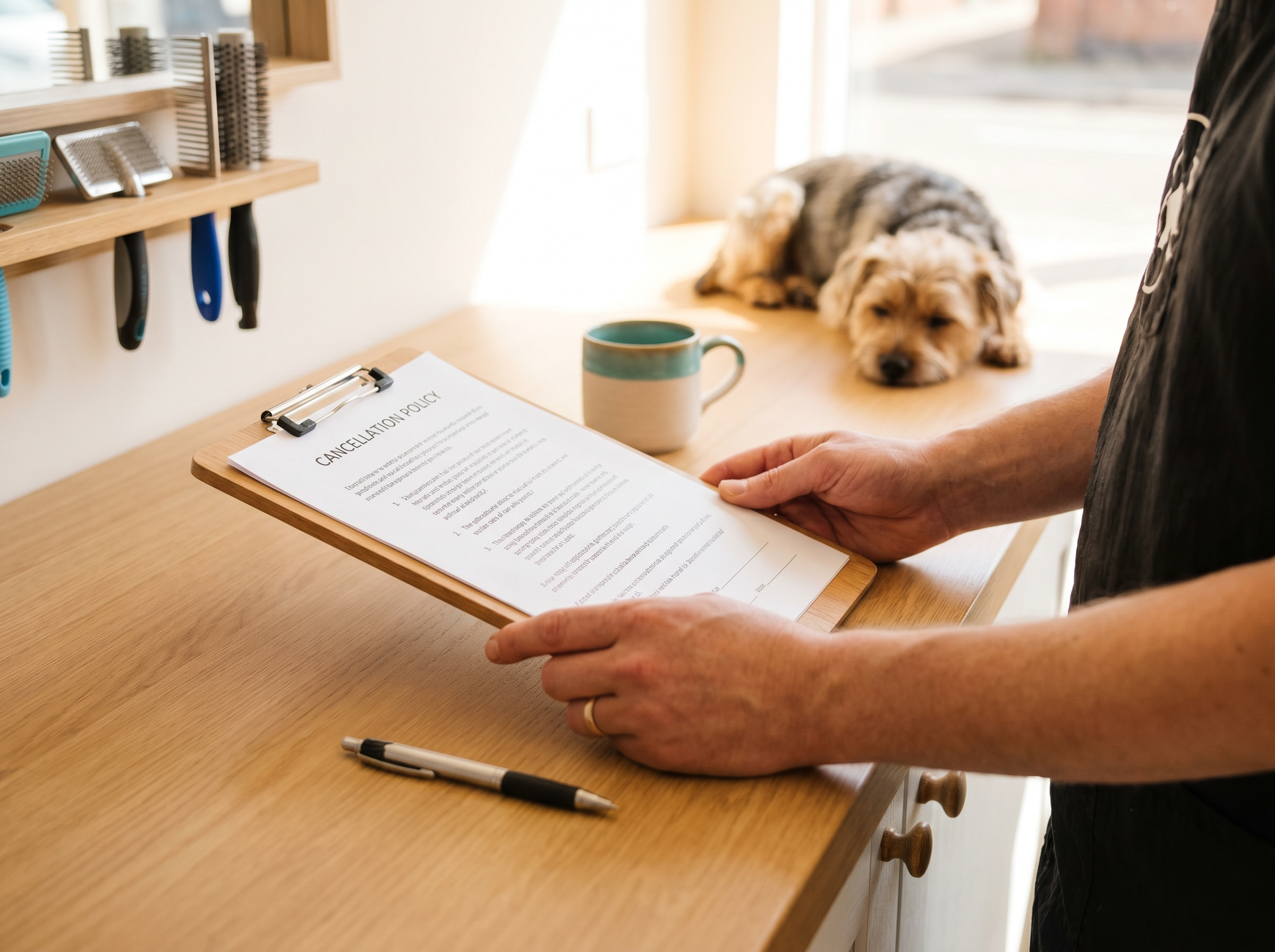
Three grooming salon cancellation policy templates you can steal
Pick whichever matches where your business is today. Swap in your numbers, your business name, and your contact info.
Template 1 — Flexible (newer business, building clientele)
Cancellation Policy
We know life happens. If you need to cancel or reschedule, please give us at least 24 hours notice so we can offer your slot to another client.
- Cancellations made with less than 24 hours notice: $25 fee
- No-shows (missed appointment without notice): 50% of the scheduled service
- Arriving more than 15 minutes late may require rescheduling, subject to a late cancellation fee
A valid payment method on file is required to book. Thanks for respecting our time — it lets us keep prices fair for everyone.
Template 2 — Standard (established solo or small salon)
Cancellation & No-Show Policy
Your appointment time is reserved specifically for your pet. To cancel or reschedule without a fee, please notify us at least 48 hours in advance.
- Late cancellations (under 48 hours): $35 per pet
- No-shows: 75% of the scheduled service price, charged to the card on file
- Late arrivals: Clients arriving more than 15 minutes late may lose their appointment and be charged as a no-show
- Repeat cancellations: After two late cancellations or one no-show, a non-refundable deposit of $50 is required to book future appointments. This deposit is applied to your service at checkout.
A valid card is required to book. Cancellation fees are charged automatically.
Template 3 — Strict (busy salon with waitlist)
Booking & Cancellation Policy
Due to high demand and our waitlist, we enforce the following policy for all grooming appointments:
- Cancellations require 72 hours notice. Cancellations made under 72 hours are charged 50% of the scheduled service.
- No-shows are charged 100% of the service to the card on file. A new non-refundable deposit is required before booking again.
- Late arrivals over 10 minutes will be rebooked as a no-show at the groomer's discretion.
- All new clients and all clients rebooking after a no-show must prepay a deposit equal to 50% of the service price. Deposits are applied to the final invoice.
- Two no-shows in a 12-month period ends the client relationship.
Appointments are confirmed only once the deposit (if required) is received.
Pick one. Print it. Put it on your website, in your appointment confirmation emails, and visibly in your salon or van. Give clients a copy at their first appointment and have them acknowledge it.
How to actually enforce your policy without losing clients
This is where the majority of grooming businesses fail. They write a great policy, post it on their website, and then… never charge anyone. Because charging a $40 cancellation fee to a regular client who texted 6 hours before their appointment feels mean. So you let it slide. And then the next person does it. And then the person after that.
Here's the framework that works.
Require a card on file for every booking
This is the single biggest change you can make. If you collect a card before the appointment is confirmed, enforcement becomes mechanical instead of emotional. The fee gets charged automatically. You don't have to send an awkward invoice. The client already agreed to the policy when they booked.
Clients who refuse to leave a card are self-selecting out of your business — and they're almost always the same clients who would no-show you anyway.
Use a consistent, non-negotiating script
When a client cancels late, you don't argue. You send a pre-written message:
Hi [Name] — no problem, I've got you down as cancelled. Per our cancellation policy, the $35 late cancellation fee has been applied to the card on file. Let me know when you'd like to rebook and I'll get you on the calendar!
Warm, specific, non-apologetic. No opening for negotiation. You're not asking permission — you're informing them that the policy they agreed to is being applied.
Enforce it the same way for everyone
The moment you waive the fee for one client "just this once," you've created a precedent. Now every client who cancels will expect the same treatment, and the ones who don't get it will be angry. Pick your policy, apply it uniformly, and build in one explicit exception: genuine emergencies. Not "something came up." Actual emergencies.
Require a deposit from repeat offenders — automatically
The fifth element of your policy (the deposit trigger) is the one that protects you long-term. After a client's second late cancellation or first no-show, their next appointment isn't booked without a deposit. Period. Not as punishment — as a filter. Clients who pay the deposit and show up are back in good standing. Clients who refuse to pay it go elsewhere, which is exactly the outcome you want.

Built-in tools that make enforcement automatic
Enforcing a policy manually means remembering which clients have how many strikes, chasing people for deposit payments, and sending awkward fee-notification messages. That's a part-time job nobody wants on top of actually grooming dogs.
This is exactly why we built ZendPaw's policy system the way we did. When you set up your grooming business, you pick one of three built-in policies — Flexible, Strict, or Full Prepay — and the system handles the rest. Deposits get collected at the time of booking through Stripe, the policy is shown to the client before they confirm, and no-shows get tracked automatically against each client's profile. The first time a chronic canceller tries to book again, the deposit requirement kicks in on its own. You don't have to remember. You don't have to chase.
The groomers who reduce their cancellation losses the fastest are the ones who stop trying to enforce policies manually and let the booking system do it. It's not that they're better at saying no — they just removed the need to say it at all.
For the bigger picture on why clients cancel and comprehensive strategies to reduce cancellations before they happen in the first place and how to reduce the underlying problem, see why grooming clients keep cancelling. To tackle the no-show side of the equation specifically, read how to reduce grooming no-shows.
Put your policy to work without the manual overhead
If you're tired of tracking cancellations in a notebook and sending awkward fee messages by hand, ZendPaw handles the whole flow — deposits collected at booking, policy shown to clients before they confirm, repeat offenders flagged automatically. You can try it free for 14 days and have your policy live by the time your next appointment books. Start your free trial — a card is required to activate the trial, and you can cancel anytime before it ends.
Frequently Asked Questions
How much should I charge for a grooming cancellation fee?
The industry standard for grooming is $25–$50 for late cancellations and 50–100% of the service price for no-shows. Newer businesses should lean toward the lower end; established groomers with waitlists can charge closer to the full service price. The fee should hurt enough that the client notices but not so much it feels punitive.
What's the difference between a cancellation and a no-show?
A cancellation is when the client notifies you they won't make the appointment — even if it's at the last minute. A no-show is when they simply don't show up without any notice. No-show fees are almost always higher than cancellation fees because you had zero warning to rebook the slot.
Can I require a deposit for grooming appointments?
Yes, and you probably should — at least for new clients, high-demand time slots, and any client who has previously no-showed. Deposits filter out unreliable bookings before they cost you anything, and they protect your revenue from the clients who stay.
Should I post my cancellation policy on my website?
Absolutely. It should be on your website, in your appointment confirmation emails, in your booking system, and visibly posted in your salon or van. Clients can't be held to a policy they never saw. The more places it appears, the more likely it is to stick.
How do I charge a cancellation fee if the client refuses to pay?
This is why having a card on file at the time of booking is non-negotiable. If the card is on file and the client agreed to the policy, you charge it automatically — no confrontation required. If you don't collect cards upfront, you're effectively running a no-enforcement policy, regardless of what's written.
Can I enforce a cancellation policy for regular, long-time clients?
You should. The best regulars are the ones who respect your policy the most. Making exceptions for favorites creates two problems: those clients stop taking your time seriously, and other clients notice the inconsistency. Apply it uniformly — your best clients will respect you more for it.
What if a client has a genuine emergency?
Build one exception into your policy for documented emergencies (illness, accident, family emergency). Handle it case-by-case, ask briefly for context, and waive the fee when it's clearly warranted. Clients remember the groomers who were understanding when they genuinely needed it — just don't let "emergency" turn into a blanket excuse.
The real goal isn't punishment — it's predictability
A cancellation policy isn't about catching clients or extracting fees. It's about running a business where your time is worth what it actually is.
The groomers who have the fewest cancellations aren't the ones with the strictest policies. They're the ones whose clients know the policy exists, trust that it'll be applied consistently, and book their appointments with that understanding built in. The policy itself is the deterrent. The fees are the backstop for when it's needed.
Write yours today. Put it everywhere. Apply it uniformly. And the next Wednesday at 9:47am when the "so sorry, something came up" text arrives, you won't stand there staring at an empty slot — you'll already be charging the fee and texting the next client on your list.
Ready to stop managing your schedule on paper?
14-day free trial · Cancel anytime
Start My Free Trial →